
Bitcoin
Bitcoin CPI
Venture Portfolio
Funds
Market Insights
Indicators






About
Contact

November 13, 2026



BTC per share measures how much Bitcoin backs each share of a company that holds Bitcoin on its balance sheet, calculated as total BTC held divided by shares outstanding. BTC yield is the percentage change in BTC per share over a period. Both track whether the Bitcoin behind each share is growing.
“Bitcoin yield” is a headline metric for many of these companies, but the name does it no favors, as it’s not a yield, pays nothing, and can rise while shareholders lose money.
In this article, we’ll go through what BTC per share and BTC yield measure, how to calculate both, and how investors can read them alongside NAV and mNAV.
When searching for “Bitcoin yield”, you’re likely to find two unrelated ideas sharing one name.
The first is the yield earned on Bitcoin. This can be done through a holder lending BTC, depositing it with a platform, or allocating to a strategy, then receiving BTC, cash or a token in return. The form that the yield takes depends on the arrangement, but it also carries counterparty, strategy, and potentially also custody risk.
The second is BTC yield as a corporate key performance indicator. Listed companies that hold Bitcoin on their balance sheets use it to report whether the amount of Bitcoin behind each share grew over a period of time. In this version, nobody receives anything, since the number only describes a change in a ratio.
This article covers this second idea.
BTC per share is calculated by dividing the total BTC held by shares outstanding.
BTC per Share = Total BTC Held ÷ Shares Outstanding
The result is a small fraction of a coin, so companies and trackers usually quote it in satoshis or sats, the smallest unit of Bitcoin. One BTC equals 100 million sats.
Take a hypothetical company that holds 1,000 BTC and has 10 million shares outstanding. Each share is backed by 0.0001 BTC, or 10,000 sats. The ratio moves whenever either side moves.
Suppose the company issues 2 million new shares to fund its operating business and buys no Bitcoin with the proceeds. Holdings stay at 1,000 BTC, the share count rises to 12 million, and BTC per share falls to 8,333 sats. Existing shareholders now own a thinner slice of the same coins. That’s simple dilution, shown through the BTC per share number.
Basic BTC per share uses only the shares that exist today. Diluted BTC per share adds the shares that could potentially exist, like convertible notes that may turn into equity, plus warrants, options, and unvested stock awards.
Strategy, whose version of the metric is the most widely cited, divides its holdings by what it calls Assumed Diluted Shares Outstanding. That count assumes every convertible note converts and every option is exercised, regardless of conversion price or vesting conditions.
The gap between basic and diluted figures can be especially wide for companies with heavy convertible issuance. Screeners sometimes don’t even label which figures they show, so the same company may show different numbers depending on the site.
The same problem affects mNAV, as covered in our guide to what mNAV is and how to calculate it. For consistent results, check the share count first.
BTC yield is calculated as the percentage change in BTC per share between two dates.
BTC Yield = (BTC per Share at End of Period ÷ BTC per Share at Start of Period) − 1
Strategy introduced and popularized the BTC yield indicator in 2024, defining it as the period-to-period change in the ratio between its Bitcoin holdings and its Assumed Diluted Shares Outstanding. By its own disclosures, Strategy reported a BTC yield of 74.3% for 2024 and 22.8% for 2025. Other treasury companies have since published their own versions of the KPI.
Let’s go back to our hypothetical company: 1,000 BTC, 10 million shares, and 10,000 sats per share. For simplicity, Bitcoin trades at $100,000, so the coins are worth $100 million, or $10 per share. The shares, however, trade at $20, twice the value of the Bitcoin behind them (an mNAV of 2.0).
The company sells 1 million new shares at $20, raises $20 million, and buys 200 BTC. It now holds 1,200 BTC across 11 million shares, or 10,909 sats per share. BTC yield for the period is 9.1%.
If you run the same raise with the shares at $10, and the company buys only 100 BTC, BTC per share stays at 10,000 sats, and BTC yield is zero. At $8 a share, it buys 80 BTC, BTC per share drops to 9,818 sats, and BTC yield turns negative.
BTC yield is a measure of the share premium. Selling equity for more than the Bitcoin it represents lifts BTC per share, and the mechanism works only while shares trade above the value of the Bitcoin behind them. This is one source of positive BTC yield. Borrowing, operating cash flow, and share repurchases can also affect the ratio.
BTC yield answers the question, “Is the Bitcoin backing each share growing?” The metric’s own definition states that it doesn’t measure anything else inside of that. Strategy’s filings state that BTC yield is “not equivalent to ‘yield’ in the traditional financial context” and set out its limitations alongside the figures.
A positive BTC yield only means the ratio of coins to shares went up. Shareholders receive no cash and no Bitcoin, and Strategy notes that presenting the KPI implies no intention to pay dividends. The word “yield” simply labels a ratio change, and nothing flows to the investor, so it’s not used in the context of “earning yield”.
The metric counts coins and shares but doesn’t account for debt in its calculation. If the hypothetical company borrows $20 million through a convertible note and buys 200 BTC, basic BTC per share rises 20% with no new shares issued. On a diluted basis, assuming conversion at $30 a share, the increase is 12.5%. Either way, it introduces a $20 million liability. Strategy acknowledges that the KPI excludes debt and other claims senior to common equity, and doesn’t consider the source of capital used to buy the Bitcoin.
BTC yield is measured in coins, so it can’t see what the coins or the shares are worth. Suppose Bitcoin halves to $50,000 after the $20 raise above. BTC yield is still 9.1%, but the Bitcoin behind each share is now worth about $5.45. An investor who bought at $20 and watches the premium disappear holds a share worth roughly $5.45 at an mNAV of 1.0, which is a loss of about 73%.
The sector already lived through a version of this. By September 2025, research firm K33 found that a quarter of public Bitcoin treasury companies traded below the value of their Bitcoin. At the start of 2026, DL News counted at least 37 of the top 100 trading below net asset value.
BTC yield is a company-defined metric, but it doesn’t have an accounting standard behind it. Each company chooses its own share count, reporting period, and treatment of debt and preferred stock. Figures appear in press releases and investor presentations, rather than in audited financial statements, so two companies reporting a 10% BTC yield may have measured different things.
Investors following Bitcoin treasury companies may look at NAV, mNAV, and BTC per share in a sequence because NAV shows what the company owns after subtracting what it owes, mNAV shows what the market pays for those assets as a multiple, and the trend in BTC per share shows whether the Bitcoin backing each share is growing.
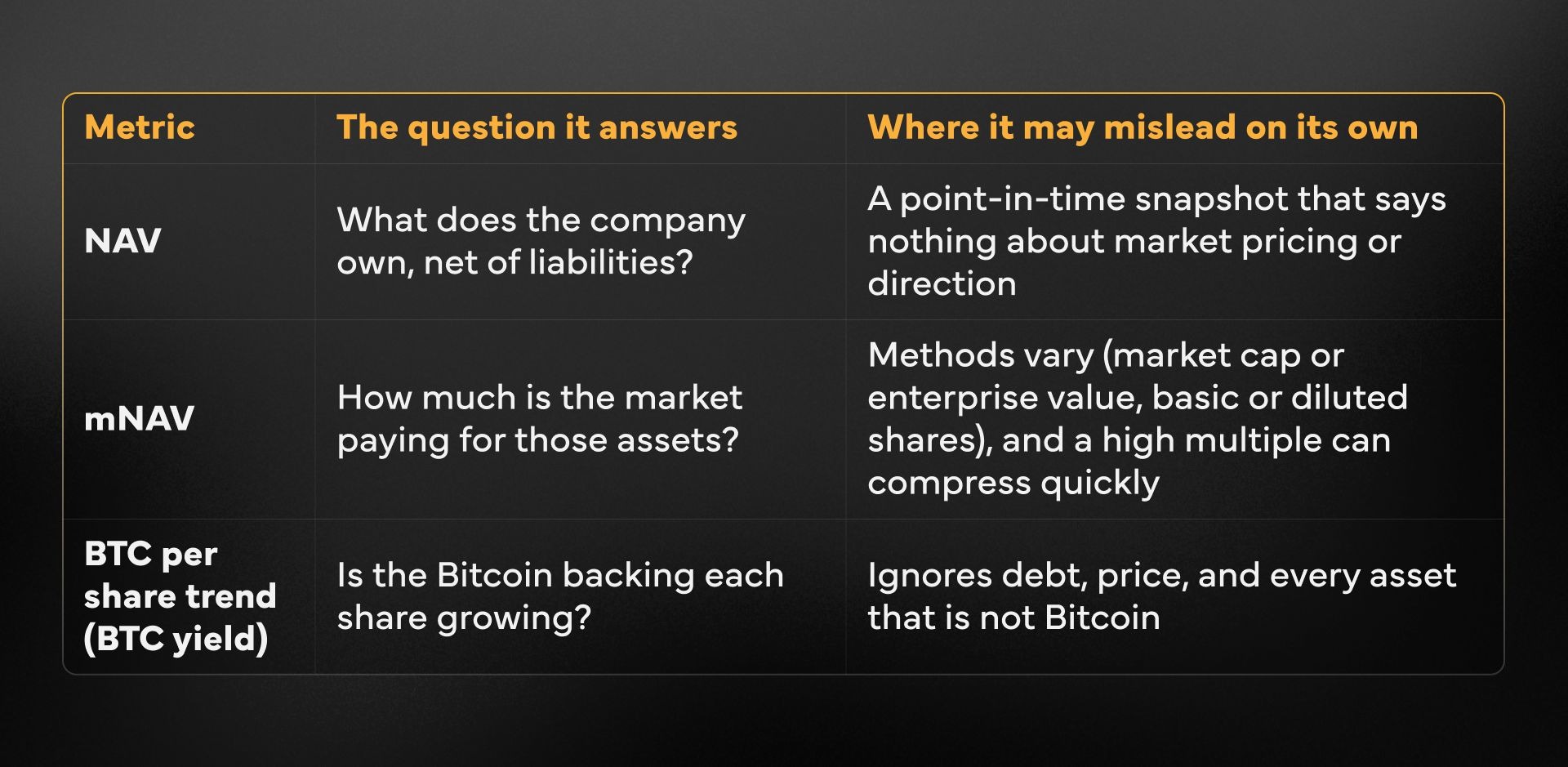
When they’re read together, these numbers can check one another. This can mean that a rising BTC per share alongside a falling mNAV can still leave shareholders worse off, while a high mNAV with flat BTC per share means investors are paying a premium that the company isn’t converting into more Bitcoin per share.
For the business model behind these metrics, see our explainer on what a Bitcoin treasury company is.
Diversified holding companies need one more adjustment. Since BTC per share counts only Bitcoin, fund stakes, private equity positions, and cash never appear in it. For these companies, the metric understates total assets by construction, and full NAV is necessary to give the complete picture.
Samara Asset Group would be an example of that. We hold Bitcoin as our primary treasury reserve asset, alongside a portfolio of venture, hedge and private equity fund investments, and publish our NAV. A Bitcoin-only metric can’t describe a balance sheet that’s built that way.
Sign up for Samara’s Monthly Market Commentary to stay current with the latest trends and developments in Bitcoin and tech-driven alternative assets.
No, BTC yield isn’t necessarily the same as earning interest on Bitcoin. BTC yield, in the sense it’s covered in this article, is a corporate KPI that tracks the percentage change in Bitcoin per share over a period of time. A positive BTC yield doesn’t pay the shareholders anything. It just tracks a change in a ratio.
Yes, BTC yield can still be positive while the stock falls. BTC yield counts coins and shares, not prices. When a company raises equity at a premium and buys Bitcoin, BTC per share rises. If Bitcoin then falls, or the market stops paying a premium for the shares, the stock can drop sharply while reported BTC yield stays positive.
A sat, or satoshi, is the smallest unit of Bitcoin, and one BTC equals 100 million sats. Sats per share expresses BTC per share as a whole number. A company with 1,000 BTC and 10 million shares has 0.0001 BTC per share, which can be read more easily as 10,000 sats per share.
Companies that track the BTC per share metric usually publish it in press releases, quarterly results and investor presentations, often next to BTC yield. Strategy reports both in its SEC filings, for example. Trackers such as BitcoinTreasuries.net compile holdings across public companies, but you should check whether a figure uses basic or diluted shares before comparing.
This article is for informational and educational purposes only. Nothing in it constitutes investment, legal, or tax advice, or an offer or solicitation to buy or sell any security or digital asset. Bitcoin and the shares of the companies mentioned, including Samara Asset Group, can rise and fall sharply in value, and past performance is no indication of future results. Always do your own research and consult a licensed professional before making any investment decision.


