
Bitcoin
Bitcoin CPI
Venture Portfolio
Funds
Market Insights
Indicators






About
Contact

November 6, 2026



A Bitcoin treasury company is a publicly traded company that holds Bitcoin as a core reserve asset as a matter of board-approved policy and discloses those holdings in its filings. Investors can see how much the company holds, what it paid, and how it funded the purchases.
The term didn't exist five years ago, but by 2025, dozens of listed companies had rebuilt themselves around Bitcoin. By 2026, they were already being sorted, rather ruthlessly, into survivors and cautionary tales. And the label itself has stretched to the point where it now covers businesses with very different balance sheets, including some that hold Bitcoin on principle while rejecting the label outright.
In this article, we'll cover what a Bitcoin treasury company is, the three business models the market tends to group under one label, how the accumulation mechanics work, what happened in 2025 and 2026, and which European companies hold Bitcoin today.
A Bitcoin treasury company holds BTC on its balance sheet as a deliberate treasury policy, rather than as a business that accepted a few coins from customers and never sold them. The policy is approved by the board and disclosed in filings.
The term spread after Strategy, then called MicroStrategy, began buying Bitcoin in 2020. The company now describes itself as the world's first Bitcoin Treasury Company. Since then, trackers and headlines have applied the label to almost any listed company with meaningful Bitcoin on the balance sheet.
Grouping them is convenient, but the economics underneath differ enough that it helps to separate three models, and the companies in the third category tend to argue the label doesn't fit them at all.
For a leveraged accumulator, Bitcoin is the entire investment case. The company raises capital through share sales, convertible notes, or preferred stock, uses the proceeds to buy BTC, and repeats the cycle for as long as investors will fund it. Any legacy operating business is small next to the Bitcoin position.
The reference case here is Strategy, and many companies that adopted the label in 2024 and 2025 borrowed from its playbook. A shareholder in this model owns a claim on Bitcoin that the capital structure amplifies. When the company can issue shares above the value of its Bitcoin, each issuance adds Bitcoin per share. When it can't, the engine tends to slow down.
The second model starts with a business that earns its own revenue. Management decides to keep part of the company's cash reserves in Bitcoin instead of currency or short-term government bonds.
Tesla and Block are the best-known examples from the public record. The Bitcoin position can be sizable, but the company is still valued mainly on its operations, and Bitcoin price moves show up as a line in the accounts rather than as the main reason to own the stock.
The third group gets filed under the treasury-company label by trackers, and pushes back on it. These are diversified holding companies where Bitcoin is the primary reserve asset inside a broader portfolio, and where the Bitcoin is put to work rather than only stored.
Deployment can mean pledging Bitcoin as collateral for financing so it doesn't have to be sold, or running strategies denominated in Bitcoin that aim to grow the Bitcoin balance itself.
Samara Asset Group is the clearest European example of this structure, and our CEO draws the line explicitly:
"I always distinguish Samara Asset Group as not a Bitcoin treasury company, but rather a company that uses Bitcoin as its primary treasury reserve asset. There's a key distinction between the two." — Patrick Lowry, CEO, Samara Asset Group
Samara is headquartered in Malta and listed on Xetra under the ticker SRAG. It holds Bitcoin as its primary treasury reserve asset, disclosed in its financial reports, alongside limited partnership positions in venture, hedge and private equity funds. The Bitcoin on the balance sheet serves the fund business: capital commitments to funds are drawn over multi-year periods, and the liquidity waiting to be called sits in Bitcoin rather than in cash.
"We're not holding Bitcoin just for the sake of holding Bitcoin. We are using it, buying, selling and liquidating as new capital calls come in to expand our fund portfolio." — Patrick Lowry
An investor here gets exposure to a portfolio and a capital allocation approach, with Bitcoin as the reserve asset underneath, which is a different proposition from a claim on an amplified Bitcoin position.
The three structures carry different risks, and they behaved very differently when market conditions changed in 2025 and 2026.
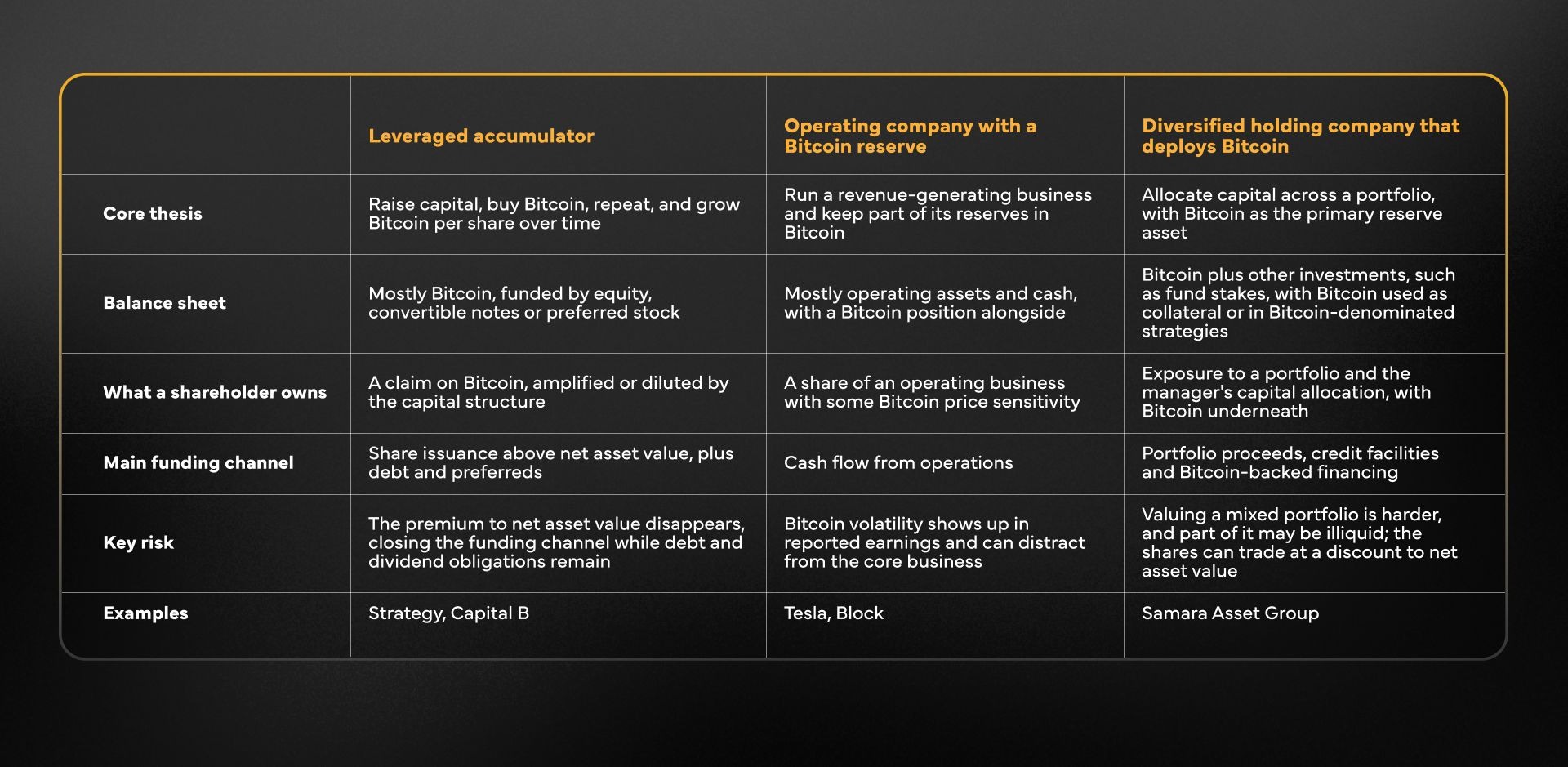
Sources: company filings and disclosures. The comparison describes structure only and is not a ranking.
Most of the mechanics people search for belong to the first model.
Accumulators fund their purchases through the capital markets. The most common tool is an at-the-market (ATM) equity program, which lets a company sell new shares gradually at prevailing market prices. Convertible notes are the second: the company borrows at a low coupon, and lenders get the option to convert into shares if the stock rises. Preferred stock has become a third channel, and Strategy has relied heavily on perpetual preferred issuance to fund much of its buying in 2026.
The math checks out when a company’s market value sits above the value of its Bitcoin, which is a ratio known as mNAV. If investors pay $1.50 for every $1.00 of Bitcoin a company holds, selling new shares and buying Bitcoin with the proceeds raises the amount of Bitcoin behind each share. Our guide to mNAV explains how the ratio is calculated and why different versions of it exist.
BTC yield is the headline metric that’s usually reported by accumulators. It measures the percentage change in Bitcoin held per fully diluted share over a period. A positive figure is seen when a company has holdings that grow faster than its share count. For example, French treasury company Capital B reported a BTC yield of 2.2% year-to-date as of late September 2026.
But there’s a known limitation, stemming from the fact that BTC yield measures accretion of BTC per share and says nothing about the return a shareholder has actually earned. The latter depends also on the share price and on how the market values the company against its holdings. Capital B itself states that these metrics shouldn’t be read as traditional investment yield or financial return measures.
BTC yield also depends on the premium. Issuing shares below the value of the underlying Bitcoin reduces Bitcoin per share, which means that the figure can turn negative. Strategy reported a year-to-date BTC yield of minus 3.7% as of October 4, 2026.
Strategy made its first BTC purchase in August 2020, while its enterprise software business continued to operate. It kept buying through every market phase that followed. Its October 26, 2026 8-K filing reports approximately 848,517 BTC held as of October 25, acquired for an aggregate $64.02 billion. The company keeps a running record of every purchase on its Bitcoin holdings page.
For several years, Strategy had few imitators. That changed in 2024 and 2025, as investors paid a growing premium for its shares and companies in Japan, the US, the UK, France, Sweden and elsewhere adopted the same approach, many of them renaming themselves along the way. Bitwise counted 48 new public Bitcoin treasuries in the third quarter of 2025 alone, citing BitcoinTreasuries.net data showing the number of listed holders rising from 124 to 172.
The count now depends on the tracker: a summary of BitcoinTreasuries.net data put the figure at 197 public companies holding about 1.273 million BTC on September 24, 2026, while CoinStats listed 173 companies holding 1.3 million BTC on October 8.
The biggest issue with the accumulator model is that it runs on a premium, whereas premiums run on sentiment, and both turned in late 2025.
Bitcoin set its all-time high on October 6, 2025, above $126,000. By late February 2026, it had fallen below $60,000, more than 50% below that peak.
Treasury company shares generally fell further than the asset they held. In early January 2026, at least 37 of the 100 largest Bitcoin treasury companies were trading below the value of their Bitcoin, according to BitcoinTreasuries.net data. In June, even Strategy’s enterprise mNAV briefly slipped below 1. By September, research from DWF Ventures found that only four of the 20 largest digital asset treasury companies, across all crypto assets, still traded at a premium to their holdings. The same report found that most of these stocks had underperformed simply holding the underlying asset since Strategy introduced the model in 2020.
Below an mNAV of 1, the playbook tends to reverse. New shares reduce Bitcoin per share instead of adding to it, so the main funding channel effectively closes. Companies carrying debt or preferred dividends still had to meet those obligations, now without access to accretive equity. Across the sector, the responses included share buybacks, consolidation talks and, in some cases, Bitcoin sales.
Companies under the same label went through the same drawdown and often came out in very different shape. This means that the label itself told investors little. Instead, much more could be learned from funding structure, leverage and everything else on the balance sheet.
There is also a deeper debate underneath the drawdown, about what holding Bitcoin on a balance sheet is for.
Samara CEO Patrick Lowry, a CPA by training, frames it through the lens every corporate finance course starts with: a CEO either allocates capital to projects that beat the company's hurdle rate, or returns that capital to shareholders.
"If your hurdle rate cannot be exceeded, it is a disservice to your shareholders not to return that cash to them. That is the fallacy behind treasury companies: the assumption that if Bitcoin is the hurdle rate, therefore you should keep Bitcoin." — Patrick Lowry, CEO, Samara Asset Group
The argument runs as follows. If a company treats Bitcoin as an investment, Bitcoin's own historical return becomes the bar every other use of capital has to clear, and very little clears it. On that logic, holding the asset and doing nothing with it is hard to defend to shareholders. The tension eases only when Bitcoin is treated as working capital, used as collateral, as a liquidity reserve against future commitments, or inside Bitcoin-denominated strategies, rather than held as a static position.
Accumulators and their investors see it differently, and the value proposition of growing Bitcoin per share is not erased by the critique. But the hold-or-use question is a useful one to bring to any company in this sector, because the answer reveals which of the three models you are actually looking at.
A spot Bitcoin ETF holds Bitcoin for its investors and uses a creation and redemption mechanism that keeps its share price close to the value of its holdings. A treasury company is different because it has no such mechanism, so its shares can trade well above or below its Bitcoin. It’s also a company, so it can borrow, issue securities, and deploy its assets.
The exact number of Bitcoin treasury companies varies by tracker and by how strictly “treasury company” is defined. In late 2026, BitcoinTreasuries.net data showed close to 200 public companies holding Bitcoin, while CoinStats listed 173 in October. A much smaller group, around 50 firms, holds at least 1,000 BTC each.
BTC yield is the percentage change in Bitcoin held per fully diluted share over a period. Accumulator companies use it as their main performance indicator. It measures how much Bitcoin sits behind each share, and it can turn negative when a company issues shares below the value of its Bitcoin.
Listed European holders include Bitcoin Group SE in Germany, Capital B in France, The Smarter Web Company in the UK, H100 Group in Sweden, and Samara Asset Group in Malta, which is listed on Xetra. Holdings and as-of dates for each are in our European listed companies tracker.
Samara Asset Group CEO Patrick Lowry rejects the label. The company describes itself as a publicly traded holding company that uses Bitcoin as its primary treasury reserve asset, disclosed in its financial reports, alongside stakes in venture, hedge, and private equity funds. The distinction its CEO draws is between holding Bitcoin as the business and using Bitcoin as the reserve asset that funds the business.
This article is for informational and educational purposes only. Nothing in it constitutes investment, legal, or tax advice, or an offer or solicitation to buy or sell any security or digital asset. Bitcoin and the shares of the companies mentioned, including Samara Asset Group, can rise and fall sharply in value, and past performance is no indication of future results. Always do your own research and consult a licensed professional before making any investment decision.


