Bitcoin
Bitcoin CPI
Venture Portfolio
Funds
Market Insights
Indicators






About
Contact

April 1, 2026



Stay up to date with our monthly market commentary:
The price of Bitcoin (BTC) increased by ~0.5% in March, closing at approximately $66,700*.
After a sharp price decline in February, Bitcoin (BTC) bounced back in the first and second weeks of March, crossing $73,500 and $74,000, respectively.
The third week of March looked even more promising, as BTC reached a monthly high of over $75,250. Unfortunately, that enthusiasm and momentum were short-lived, as heightened tensions in the Iran conflict dragged the crypto market lower.
Bitcoin holders appeared to favor immediate liquidity over long-term positions as geopolitical frictions between the U.S. and Iran intensified further, mirroring a pattern also seen in February. This shift triggered a significant sell-off shortly after Bitcoin hit its monthly peak.
Spot Bitcoin ETF data mirrored this trajectory. During the first half of March, net inflows across all 11 funds rose steadily, briefly surpassing spot gold ETFs' performance. This positive momentum persisted for seven consecutive trading days until the price corrected, prompting ETF investors to increase selling activity throughout the second half of the month.
In the second half of March, Bitcoin dropped by over 11% from its monthly all-time high, closing the month around $66,700. Slightly higher than the last 30-day trading interval.
The broader crypto asset market saw a mixed month. While large-cap crypto assets like Bitcoin (BTC) and Ether (ETH) rebounded modestly in March, other assets, including Hyperliquid, Tron, Solana, and Bitcoin Cash, delivered gains.
In contrast, the remainder of the crypto market faced another period of decline, with downward price corrections of 2% to as high as 12%.
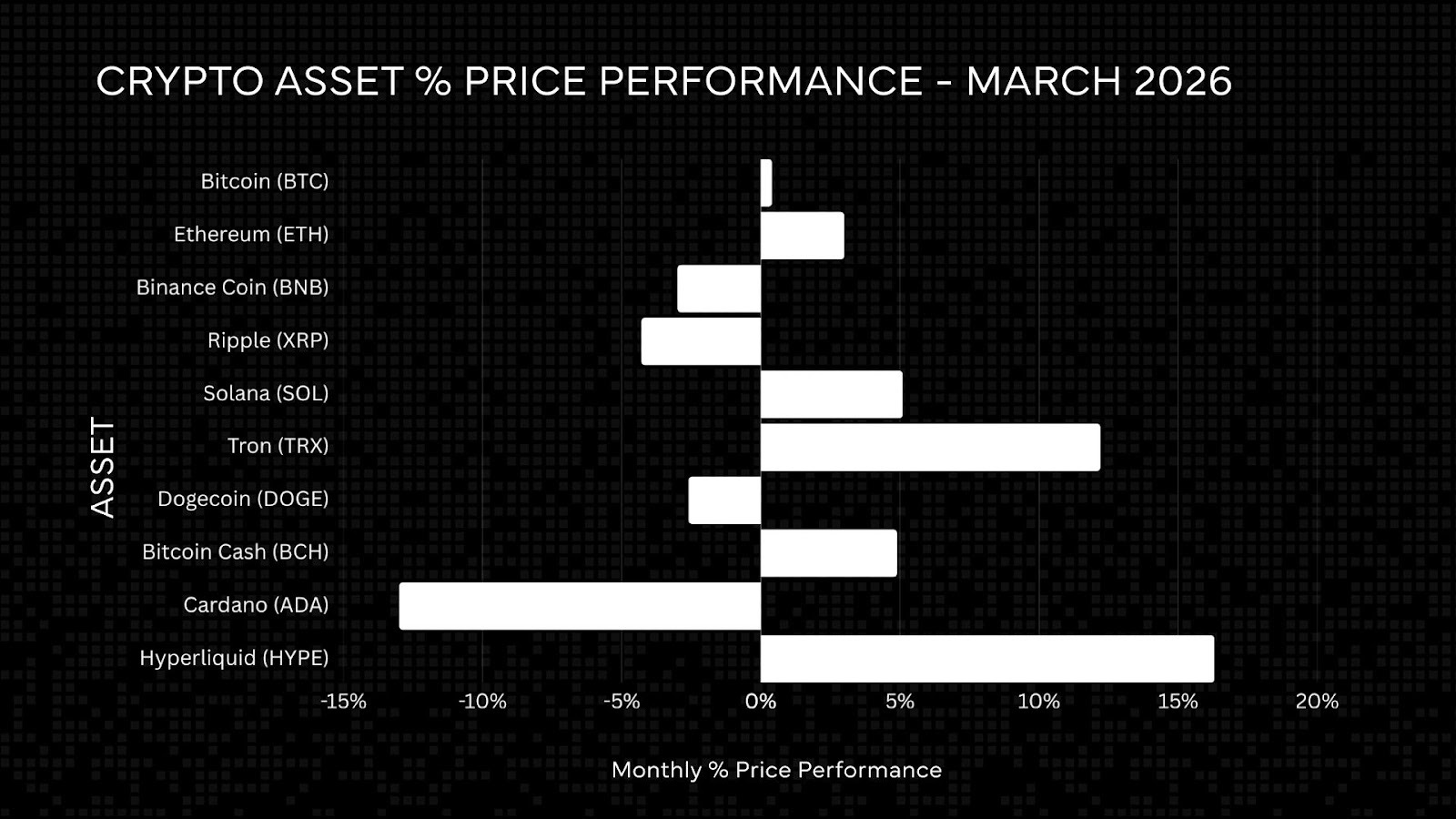
During the first two weeks of March, Bitcoin (BTC) staged a strong recovery from its February decline, peaking at a monthly all-time high of over $75,250. However, the largest crypto asset was subsequently pulled down by friction in the U.S.-Iran conflict, ending the month at $66,700, marking a modest 0.4% increase over the previous 30-day period.
Ethereum (ETH) recorded a strong month-on-month performance of 3% and increased trading volume in its Decentralized Finance (DeFi) segment, while also seeing the Dencun upgrade, which significantly lowered transaction fees on Layer 2 networks.
The best-performing crypto assets this month were Hyperliquid (HYPE), Tron (TRX), and Solana (SOL), with performance of 16.3%, 12.2%, and 5.10%, respectively. The remainder of the top crypto assets declined by 2% to 4.5%, except for Cardano (ADA), which saw a sharp 12.6% correction amid selling pressure throughout the second half of the month.
In a landmark move, U.S. regulators issued a transformative announcement regarding the classification of digital assets, while Kraken became the first cryptocurrency exchange to secure a Federal Reserve Master Account.
The regulatory push in the U.S. continues at a rapid pace. This month, both the SEC and the CFTC issued a 68-page joint interpretation, introducing a five-pillar token taxonomy and designating 16 crypto assets as examples of digital commodities.
The joint interpretation further established five distinct categories for classifying digital assets in the future. These are:
Along with these five categories, the SEC and CFTC also established guidelines and guidance surrounding staking, airdrops, and token wrapping, elaborating in detail on how issuers and investors alike should behave with these instruments.
SEC Chairman Paul S. Atkins had the following to say in the SEC press release: “After more than a decade of uncertainty, this interpretation will provide market participants with a clear understanding of how the Commission treats crypto assets under federal securities laws. This is what regulatory agencies are supposed to do: draw clear lines in clear terms.”
These initiatives are also in line with the current U.S. Administration's goal of establishing the United States as the global hub for cryptocurrency. The last leg in that push is the Market Structure Bill and the CLARITY Act. Both are currently in the spotlight on Capitol Hill, with expected voting in the near future.
Kraken Financial, the Wyoming-chartered subsidiary of one of the sector's most long-standing exchanges, revealed earlier this month that it has secured a Federal Reserve Master Account. This milestone makes it the premier digital asset bank in the United States to obtain direct access to the Federal Reserve's payment systems.
Arjun Sethi, Co-CEO of Payward and Kraken, said in the press release: “This milestone marks the convergence of crypto infrastructure and sovereign financial rails. With a Federal Reserve master account, we can operate not as a peripheral participant in the U.S. banking system, but as a directly connected financial institution.”
Through this achievement, Kraken gains access to Fedwire, the Federal Reserve's real-time settlement infrastructure. This system facilitates the instantaneous transfer of US dollar-denominated funds and securities among financial institutions. By bypassing intermediary banks, the exchange can now provide more rapid settlement for both its own operations and its clients' transactions.
*Closing price data is from March 31st 2026, at 15:00 CET