Bitcoin
Bitcoin CPI
Venture Portfolio
Funds
Market Insights
Indicators






About
Contact

October 2, 2026



Stay up to date with our monthly market commentary:
Bitcoin continued its rally in September, trading around $84,000 at month-end, approximately 7.4% above its August level.*
This was the fourth consecutive September in which BTC finished higher. Before that streak, the month had closed in the red in eight of the 13 years from 2013 through 2025, according to CoinGlass data.
To kick off the month, Bitcoin briefly moved above $82,000 on September 3rd, a day when U.S. spot Bitcoin ETFs took in around $731 million.
The middle of the month brought two policy setbacks in as many days. On Tuesday, September 15, the U.S. Senate failed to invoke cloture on the motion to proceed to the CLARITY Act, the proposed crypto market structure bill, in a 49–50 vote (one senator did not vote), short of the 60 needed to open debate. Bitcoin dipped just below $75,000, its lowest level of the month.
A day later, the Federal Reserve raised its benchmark rate by 25 basis points to a range of 3.75% to 4.00%. It was the Fed's first increase since July 2023, and the median projection of policymakers points to one further hike before year-end.
Bitcoin, however, remained firm and absorbed both. The price rose back above $81,000 on September 18, and on September 21 BTC reached an intra-month high of around $87,360, an eight-month high, as spot ETFs recorded their largest single-day inflow of the year.
The rally cooled in the final week of the month, with Bitcoin trading between roughly $82,500 and $85,600 through to the end of September.
Most major cryptoassets followed Bitcoin’s lead and finished September higher than August. The most notable performer was ZEC.
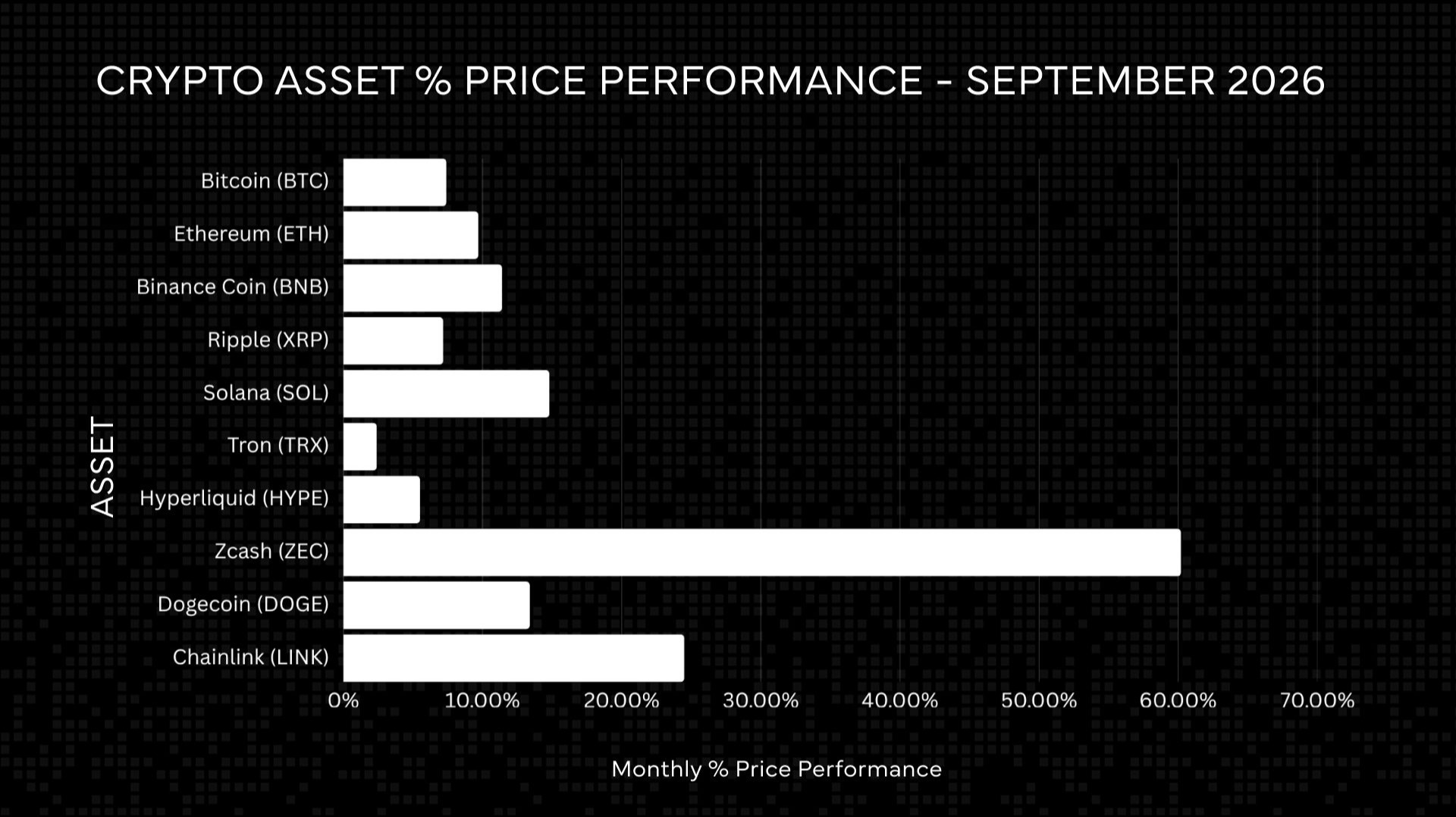
Bitcoin (BTC) opened the month around $78,000 and rallied up to $87,000, before correcting down to around $84,000* to close out the month. As usual, the rest of the digital asset market followed.
Zcash (ZEC) was again the strongest performer among the largest assets by market cap, gaining 60.2% after an 80% rally in August. In early September, ZEC moved above $1,000. Institutional products added to demand, with Grayscale’s Zcash ETF (ZCSH), which listed on NYSE Arca on August 25th, continuing to attract inflows, and 21Shares launching a ZEC exchange-traded product on Euronext. The token traded above $1,600 on September 23 before easing into month-end.
Chainlink (LINK) followed with a gain of 24.5%. The token reached its highest level of 2026 on September 29, a day after the launch of version 2.0 of Chainlink's Cross-Chain Interoperability Protocol (CCIP), which added built-in compliance controls aimed at institutional users.
September brought the launch of a European service for settling tokenized assets in central bank money and the largest single day of U.S. spot Bitcoin ETF net inflows in 2026.
On September 21, Eurosystem launched Pontes, a service that allows wholesale transactions in tokenized assets to be settled in central bank money. It’s the first initiative to go live under the Eurosystem’s strategic program for tokenized finance.
Pontes connects market distributed ledger technology (DLT) platforms with TARGET Services, the Eurosystem’s payment and settlement infrastructure. Participants can settle the cash leg either with cash tokens on the Eurosystem's own DLT platform or directly in T2, its real-time gross settlement system.
The first participants include Deutsche Bank, Santander, Société Générale, DZ Bank, BayernLB, DekaBank and ABANCA, alongside public institutions such as the European Investment Bank, KfW and France’s Caisse des Dépôts. Clearstream, SWIAT, Cashlink and Axiology are connected as DLT operators. The Eurosystem plans to add features and extend operating hours step by step, with full implementation expected by 2028. ECB Executive Board member Piero Cipollone said Pontes “brings the stability and trust of central bank money” to Europe's tokenized finance ecosystem.
On the same day, the ECB announced that it has begun preparatory work to invest a small portion of its own funds in tokenized securities, with the purchases settled through Pontes.
Initial investments will focus on euro-denominated securities issued by euro area central and regional governments, agencies and European supranational institutions. The own funds portfolio sits outside monetary policy and generates income to help cover the ECB's operating costs. The Executive Board has yet to decide on the timing and operational details.
U.S. spot Bitcoin ETFs took in $999 million in net inflows on September 21, the largest single-day total of 2026 and the highest since October 6th, 2025, according to data from Farside Investors and CoinGlass.
BlackRock’s iShares Bitcoin Trust (IBIT) led with $381 million, followed by the ARK 21Shares Bitcoin ETF (ARKB) at $289 million and the Fidelity Wise Origin Bitcoin Fund (FBTC) at $239 million. The Morgan Stanley Bitcoin Trust (MSBT) added $62 million.
The inflow coincided with Bitcoin’s move above $86,000, a level Bloomberg ETF analyst Eric Balchunas identified as roughly the average cost basis of ETF investors. The run of inflows also turned year-to-date flows positive. In mid-July, the funds had been sitting on around $5.7 billion in net outflows for 2026.
Across September as a whole, spot Bitcoin ETFs recorded roughly $2.65 billion in net inflows, based on Farside daily data, below August’s $3.54 billion. Cumulative net inflows since the funds launched in January 2024 stood at about $57.56 billion at month-end.
*Closing price data is from October 1st, 2026, 3:00 pm GMT.