
Bitcoin
Bitcoin CPI
Venture Portfolio
Funds
Market Insights
Indicators






About
Contact

July 3, 2025


With the rise of artificial intelligence (AI), crypto AI agents are becoming a growing trend in the digital asset industry. These tools use AI to analyze data, make decisions, and even take action without the need for constant user input.
Read on to learn what crypto AI agents are, how they work, and how they’re impacting the digital asset market.
Crypto AI agents are computer programs that interact with blockchain networks and act autonomously or semi-autonomously.
Interest in them surged after the launch of the memecoin Goatseus Maximus (GOAT), which was created by an AI bot called Truth Terminal.
Since then, the space has expanded.
At first glance, they may seem similar to bots. However, AI agents are fundamentally different. They use artificial intelligence and machine learning, so they can handle more complex tasks, adjust as they go, and learn.
AI agents in crypto work as assistants that perform different tasks. This process is based on a layered architecture.
First, they collect on-chain data. This might include metrics like trading volume and token price, as well as trends and opinions from social media. Once the data is collected, agents analyze it.
For example, they may notice that the trading volume of a token has suddenly increased and that influencers have started talking about it.
Based on this, they find cause-and-effect links and make conclusions. The final layer is task execution. Using the conclusions from the analysis, the agent can take action. For example, buy an asset with leverage or sell it.
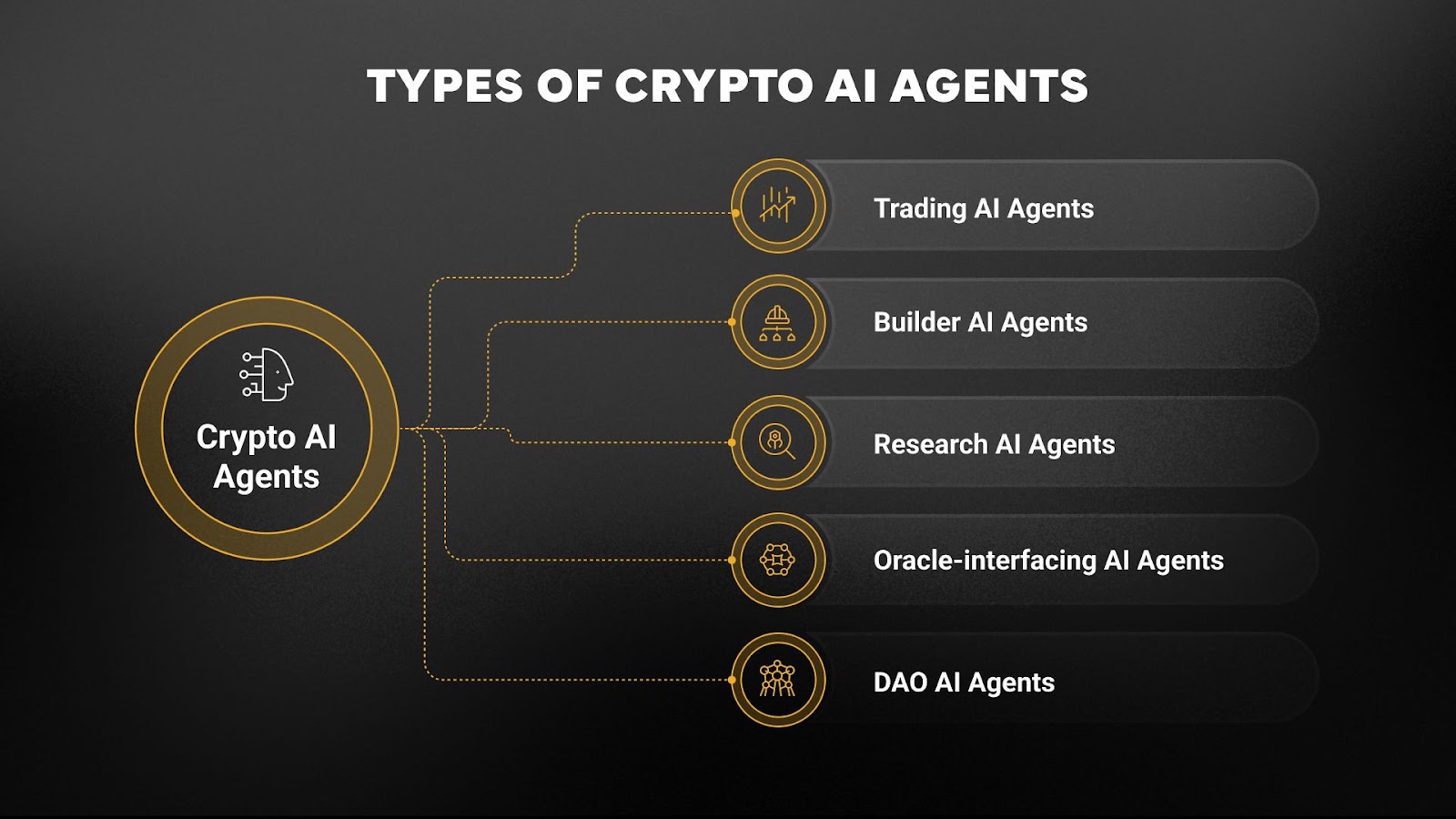
There are many types of crypto AI agents, each designed for a specific task, since there is no universal AI agent that can handle everything at once. This focus makes AI agents valuable because they’re built to solve a particular problem, which improves how well they perform.
The main types include:
Different types of crypto AI agents can work together. A user may rely on several agents at once to simplify workflows and save time by automating repetitive or complex tasks.
Today’s crypto AI agents are mostly used to help traders and investors.
These agents can monitor market data, track what’s being said on social media, and follow the latest discussions around a project.
One key advantage is that they can work autonomously as well, so they don’t require constant input from the user. By analyzing information and acting on their own, AI agents help you make better decisions and react faster. In turn, as more people start using these programs, the market might become even more dynamic and liquid, as simplified trading might encourage more newcomers to enter this space.
By helping with the tasks below, crypto AI agents might help democratize and grow the digital asset market even further.
One of the main use cases for crypto AI agents is trading. A key advantage is that these agents can interact not only with centralized exchanges (CEXs) but also with decentralized exchanges (DEXs). Some DEXs can be harder for traders because they require more technical knowledge. An AI agent can handle this complexity. It monitors token data and makes decisions based on the analysis.
AI agents also simplify access to decentralized finance (DeFi). For example, they can search for better yield farming opportunities or help you optimize returns across different DeFi platforms.
Another important use case for crypto AI agents is portfolio management. One of their main tasks is to monitor and mitigate risks based on the chosen trading strategy. They can also adjust the strategy if the market changes and rebalance your portfolio. AI agents track market trends and make conclusions based on the data they collect.
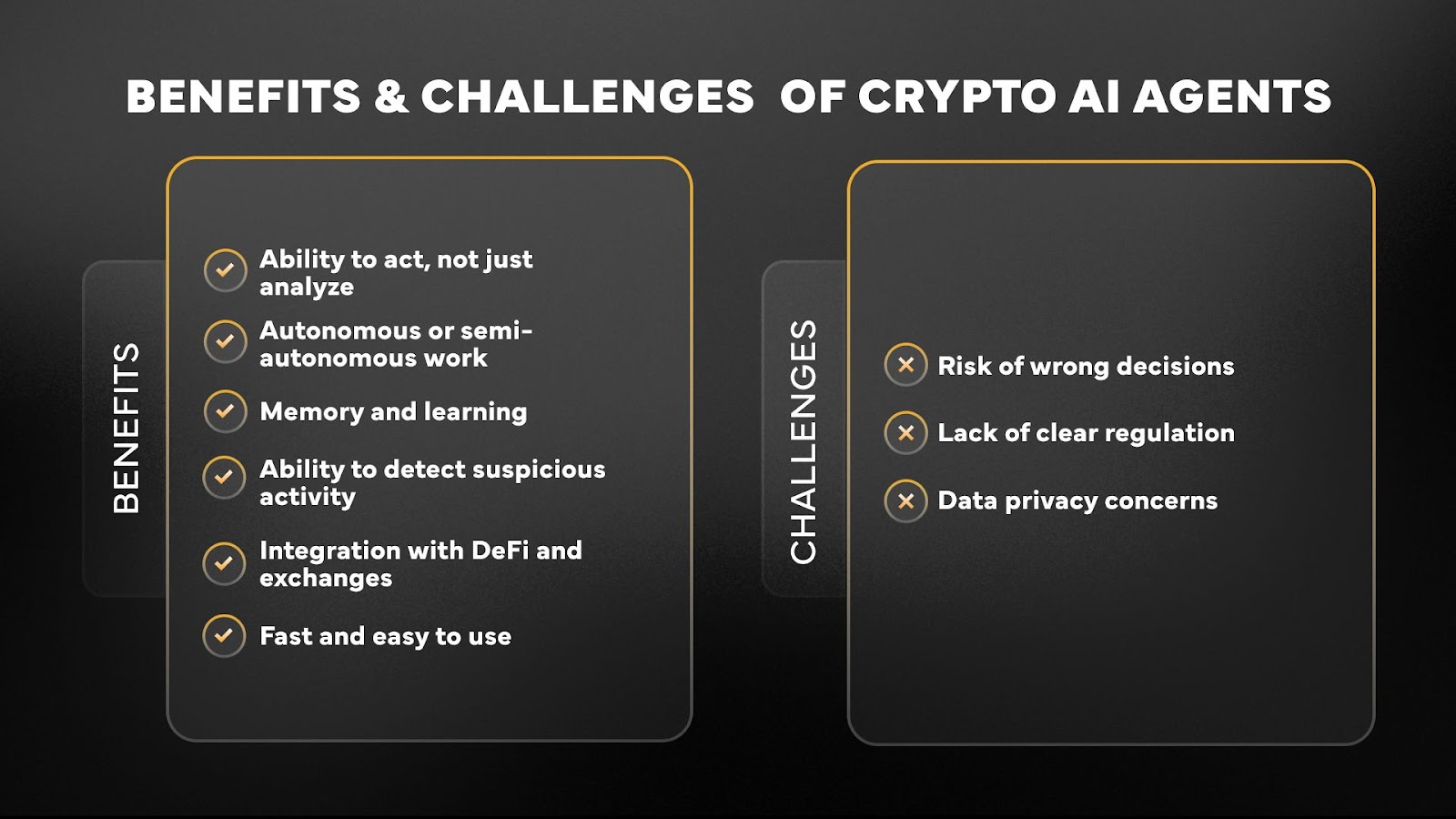
Crypto AI agents can offer several key benefits, as these programs not only analyze data, but can also take action based on that analysis.
AI agents are designed to take on tasks that are too complex for simple bots.
AI agents can complete tasks after analyzing data. They don’t stop at giving insights but follow through by executing actions, such as trading or interacting with smart contracts.
AI agents can work fully autonomously or with minimal user input. This helps you save time by letting the agent handle certain tasks without needing constant attention.
AI agents have a memory model. They learn and remember trends over time. Based on this, they can adjust their actions or fine-tune your trading strategy as market conditions change.
AI agents can identify unusual on-chain behavior, such as large token transfers or patterns of related transactions. This can be useful for platforms that need to spot risks, like validators, exchanges, or other monitoring systems.
AI agents can interact with DeFi platforms, wallets, exchanges, and other cryptoasset services. They’re able to perform actions across different platforms on your behalf.
AI agents are built to be both user-friendly and efficient. They are easy to use, even without coding skills, and can react much faster to market events than a human. This helps you save time and take advantage of opportunities as they happen.
AI agents in crypto offer many benefits, but they also come with challenges and risks. Here are some of the main issues to consider.
While autonomy is one of the strengths of AI agents, it can also be a weakness. An AI agent might make the wrong decision if the market is manipulated or if there’s an attack on the blockchain. Since the agent interacts directly with your cryptoassets, a wrong move could lead to financial losses.
There’s no clear regulation for AI agents in crypto. It’s still unclear who is responsible if an AI agent makes a bad decision that causes losses for the trader. This legal uncertainty increases risks for anyone relying on them.
AI agents interact with your personal data and collect information as they operate. This raises questions about data protection, privacy, and how securely your information is stored and used.
Crypto AI agents are still an emerging technology, but they’re growing fast as more projects and traders explore their potential.
These tools are not only fast and efficient but also simplify how you interact with the cryptoasset market. Given their ability to learn, adapt, and remember trends, AI agents could play a bigger role in trading, portfolio management, and blockchain governance. Solving challenges like regulation and security will be key to building trust and supporting wider adoption.
A crypto AI agent analyzes blockchain data, makes decisions, and takes actions like trading or voting. It works autonomously or semi-autonomously to simplify tasks that would normally need manual input. It performs the tasks it is designed or trained to do and can learn from its experience.
You can buy AI agents crypto tokens on major centralized exchanges like Binance or Coinbase. Some tokens are also available on decentralized exchanges, depending on the project. These assets not only represent the value of the agents but are also used for governance and utility functions.
Crypto AI agents are useful but carry risks because they act fully- or semi-autonomously. A wrong decision or an unexpected market event could result in losses, so you should monitor them carefully. It is important to treat each project independently in determining its safety.


