Bitcoin
Bitcoin CPI
Venture Portfolio
Funds
Market Insights
Indicators






About
Contact
The Bitcoin Puell Multiple examines Bitcoin market cycles by comparing daily Bitcoin miner revenue to its long-term historical average.

The Puell Multiple measures Bitcoin’s price cycles by comparing daily miner revenue to its long-term historical average.
When miner revenue is significantly above the yearly average, miners are more likely to sell, which can increase downward pressure on the price of Bitcoin. Conversely, when miner revenue is well below average, it signals miner income stress, which typically results in reduced immediate selling pressure on Bitcoin.
Alongside ETFs and other institutional investors, miners are significant holders of Bitcoin, which means their profits can influence selling pressure.
The logic is simple. Miners usually cover expenses by selling BTC. When revenue rises, they sell more. When it falls, they draw from fiat reserves instead. In both cases, it can affect Bitcoin’s price.
The Puell Multiple indicator compares what miners earn today versus their average earnings over the past year in USD.
The formula is:
Puell Multiple = Daily BTC Issuance Value (USD) ÷ 365-day Moving Average of Daily Issuance Value (USD).
or example, if miners earned $10 million today and the yearly average is $2 million, the Puell Multiple would be 5. In this case, miner profits would read sharply above the norm, meaning miners are likely to sell more.
The Puell Multiple is interpreted as follows:
Some platforms use a downward-sloping line instead of a fixed red zone. This reflects Bitcoin halving events, which cut block rewards in half. The last halving event occurred in April 2024 and reduced the reward from 6.25 to 3.125 BTC/block. As a result, the upper range of the Puell Multiple dropped.
On-chain trading analyst David Puell created the Puell Multiple to track how miners' behavior influences Bitcoin market cycles.
Today, his indicator is used in trading analysis to identify shifts in long-term BTC trends. Additionally, Puell is the co-creator of the Market Value to Realized Value (MVRV) metric.
Historically, the Puell Multiple has coincided with major BTC reversals ahead of time, especially during periods of overheating.
In 2013, the Puell Multiple broke above the red zone in April, reaching 10.48. One day later, BTC began to drop. In early November of the same year, the Puell Multiple again rose above 9, entering the red zone. This occurred a week before Bitcoin peaked at $1,134.
The indicator signaled overheating when the price was just above $300. After peaking at the end of November, both the price and the multiple began to decline in the following weeks.
In 2017, the indicator pointed to profit-taking when Bitcoin was near $11,000. Two weeks later, it hit an all-time high of around $19,000 before falling sharply.

The Puell Multiple has proven reliable in the green zone as well. In 2011, 2015, 2018, and 2020, it fell below 0.5, correlating with periods of market panic and price bottoms.
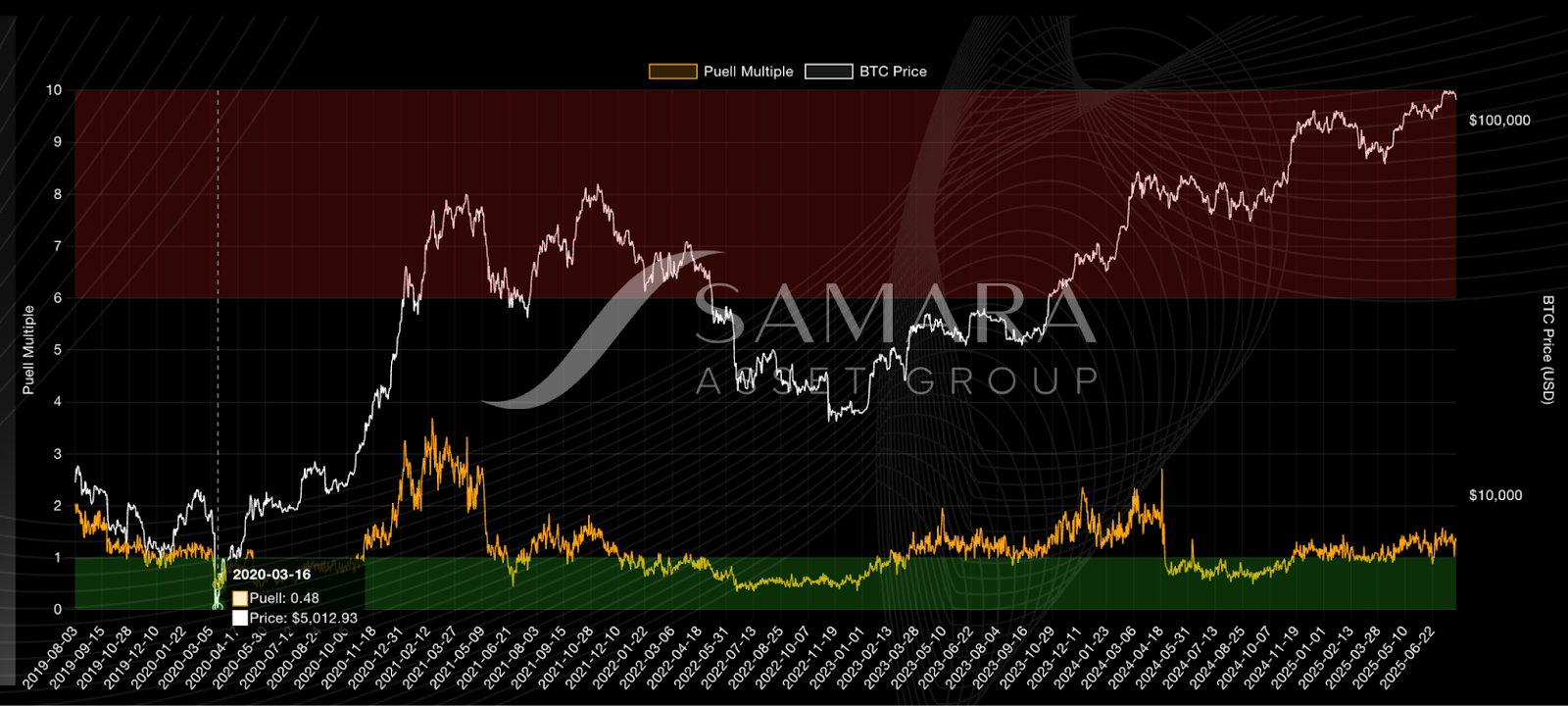
It should be noted that the Puell Multiple is potentially useful for position trading but not for intraday traders. On its own, it's unlikely to form the basis of a trading strategy. Only when combined with other tools, such as the Hash Ribbon indicator, for example, can it potentially help to spot price trends.
Here is a summary of the benefits and limitations of the Puell Multiple.
The Puell Multiple could be used to identify market overheating and periods of corrections. Additionally, it’s easy to read, making it accessible even for beginners.
Here’s what the Puell Multiple does:
The indicator won’t provide an exact entry point, but it helps identify the potential direction of the market.
Keep in mind that the Puell Multiple isn’t a comprehensive tool. It provides valuable insight, but not a full view of the market.
The limitations of the Puell Multiple include:
To use this indicator effectively, combine it with other tools and take into account the broader context.