
Bitcoin
Bitcoin CPI
Venture Portfolio
Funds
Market Insights
Indicators






About
Contact

September 30, 2025


Bitcoin has evolved beyond peer-to-peer transactions and acting as a store of value to support decentralized applications, also known as dApps. These Bitcoin dApps benefit from the security and decentralized nature of the Bitcoin network while expanding its usability to Internet-native financial services, digital marketplaces, and more.
This guide explores the growing ecosystem of dApps on Bitcoin. With it, you will learn how they function, what the leading examples are, and why their development makes sense.
Decentralized applications (dApps) are software applications that run on blockchain networks, powered by smart contracts.
Smart contracts are pieces of code that automatically execute certain predefined conditions. A dApp is a collection of smart contracts grouped together to carry out particular functions on a blockchain network without a centralized authority.
Such applications have a range of use cases, including in finance, gaming, social media, supply chain management, healthcare, education, and more. In these areas, they safeguard user privacy, increase security, and facilitate efficient, transparent operations.
Yes, you can.
However, it is difficult to build dApps directly on the Bitcoin blockchain due to its limited smart contract functionality.
dApps require expressive and complex smart contracts to work, which Bitcoin Layer 1 doesn’t support by default. Bitcoin can only handle simple smart contracts as a result of the limited programmability of its scripting language.
The purpose of this limitation is to reduce programming errors and the risk of denial of service (DoS) attacks.
To address this, developers primarily use layers and sidechains that connect to the Bitcoin blockchain. These add smart contracts, move some activity off the main chain, and improve speed.
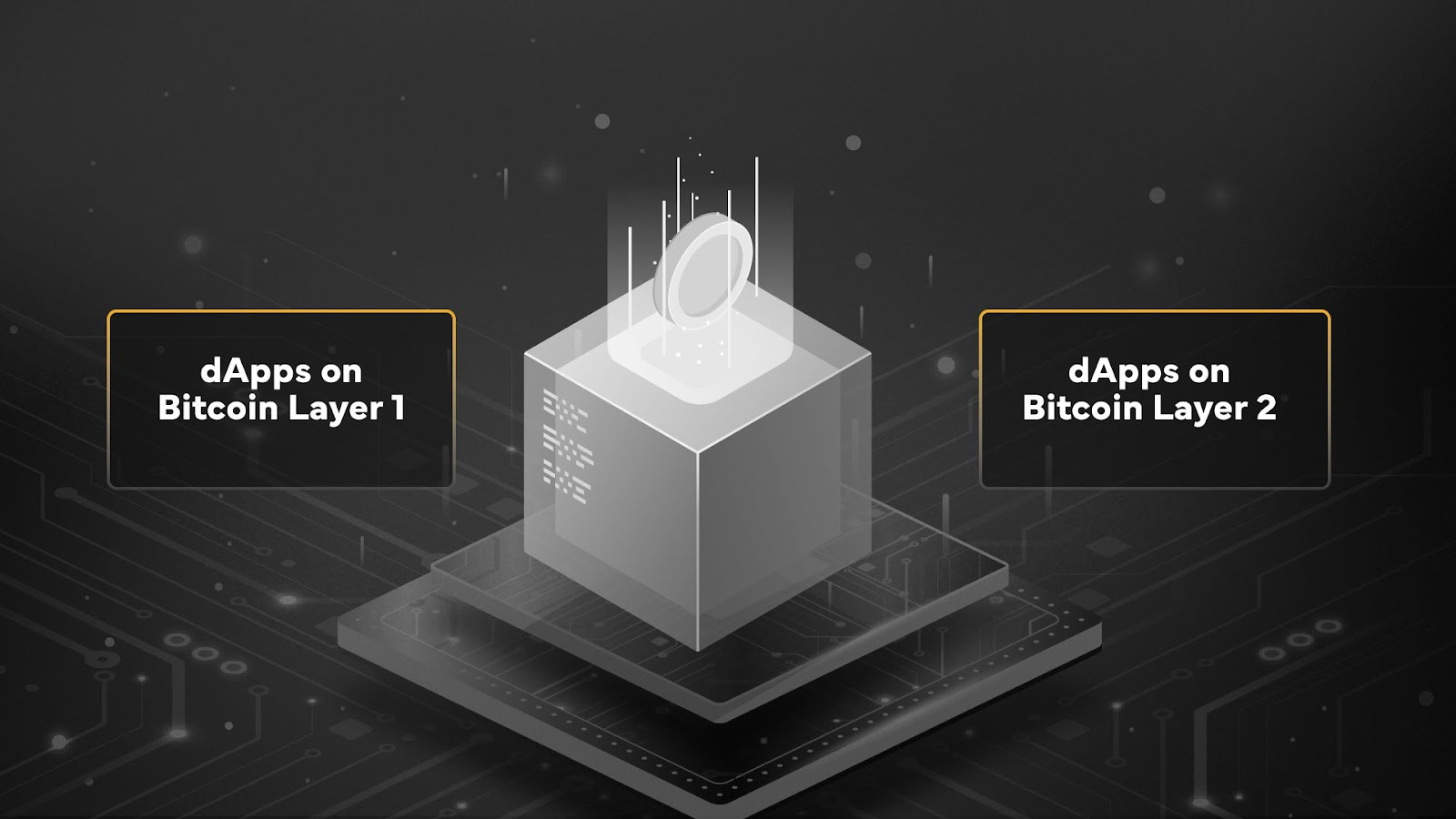
Most Bitcoin dApps run on smart contract-focused Bitcoin layers that use the base layer’s security, decentralization, and immutability to support stable and decentralized operations.
These are separate or off-chain protocols that expand Bitcoin’s smart contract functionality through an elaborate programming language or compatibility with the Ethereum Virtual Machine (EVM).
However, there are also a handful of dApps that operate directly on the Bitcoin blockchain.
Although direct dApps on Bitcoin Layer 1 are limited due to its simple scripting language, certain tech innovations enable some applications, such as LiquidiumWTF and Odin.fun, to operate efficiently as de facto Layer 1 dApps.
In LiquidiumWTF’s case, these include Partially Signed Bitcoin Transactions (PSBTs), permitting multiple parties to review and sign transactions before broadcasting, and Discreet Log Contracts (DLCs), enabling the creation of private, enforceable smart contracts. Additionally, the 2-of-3 multisignature escrows require two of the three involved parties (the borrower, lender, and a Liquidium oracle) to sign off to unlock the collateral.
As a hybrid application, Odin.fun bypasses the limitations of Layer 1 through the use of the Runes protocol and the ICP ecosystem’s speed, core trading logic, bonding curves, and smart contract functionality relying on a “chain abstraction” process. Users can deposit BTC from the Layer 1 network into Odin.fun because ICP’s “chain fusion” supports integration with Bitcoin.
Layer 2 solutions add the smart contract flexibility needed to build Bitcoin dApps for decentralized finance (DeFi). Computation happens off-chain or on a separate chain that periodically settles back to Layer 1, thereby profiting from its finality and security.
Platforms like Sovryn utilize Rootstock (RSK), an EVM-compatible sidechain that shares Bitcoin’s mining hashrate. This helps Sovryn offer a full collection of DeFi services like spot and perpetual trading, lending, and borrowing.
ALEX operates on the Stacks layer, which uses a unique proof-of-transfer (PoX) mechanism to settle its state on Layer 1. Thanks to this technology, ALEX can offer automated market makers (AMMs) and similar services, all secured by the Bitcoin blockchain.
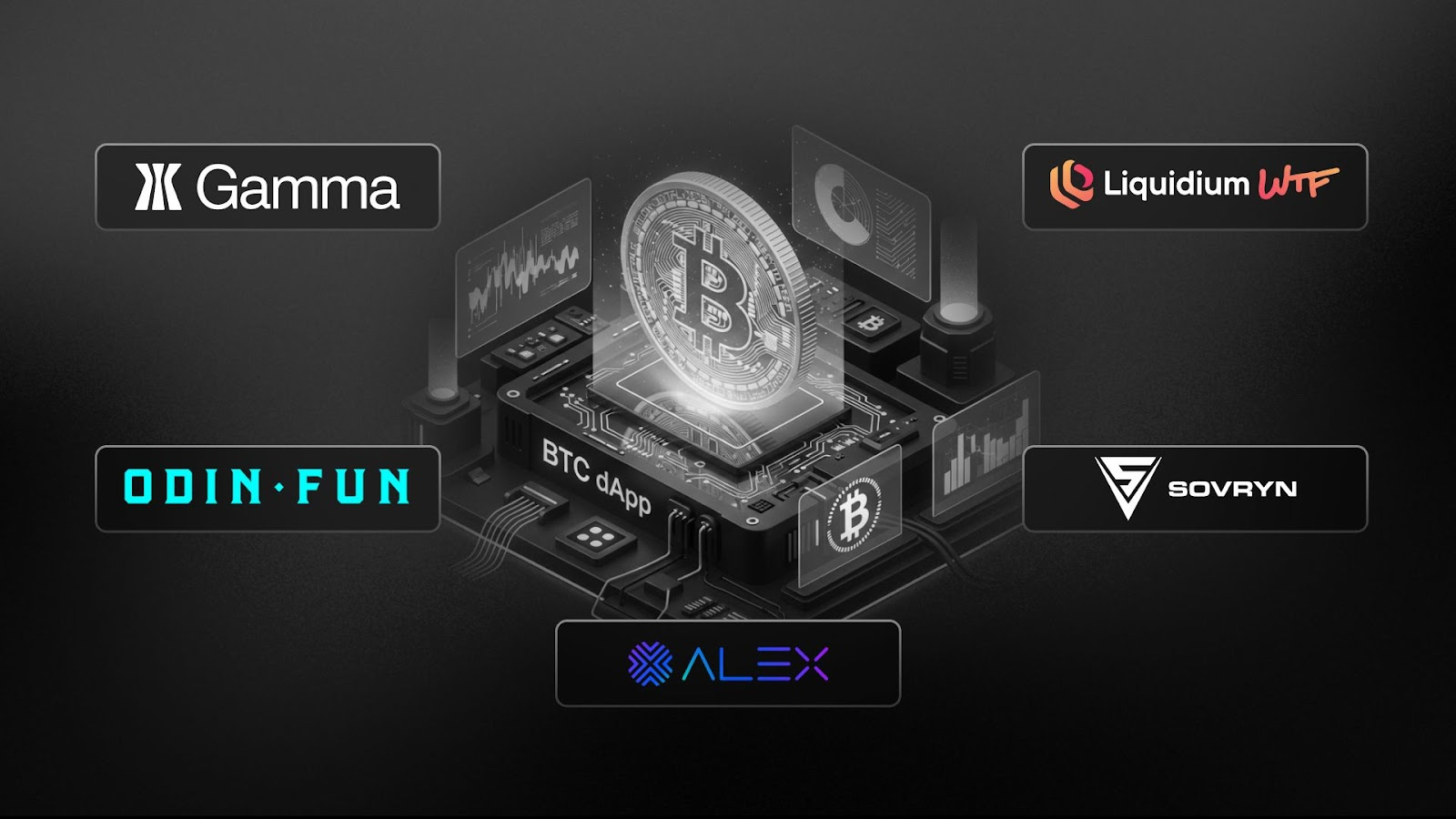
Some examples of the top Bitcoin dApps include:
Short for Automated Liquidity Exchange, ALEX is a DeFi platform that enables financial services on the Bitcoin blockchain. It leverages the Stacks protocol as a Layer 2 solution, with all transactions and dApps secured and settled on Layer 1.
LiquidiumWTF is the leading decentralized P2P lending platform built on the Bitcoin blockchain. Users can secure BTC loans with Ordinals, Runes, and BRC-20 as collateral, or lend BTC to earn interest.
Gamma is a Bitcoin NFT marketplace and social platform created on Stacks. It lets users buy and sell Bitcoin Ordinals and NFTs issued on the Stacks network directly from their wallets. Additionally, Gamma lets users mint Stacks NFTs and inscribe Ordinals.
Odin.fun is a platform designed for fast creation and trading of tokens on the Bitcoin network. It was inspired by the pump.fun model and relies on the Runes protocol and ICP to facilitate near-instantaneous token transactions. On top of that, the platform’s Valhalla protocol supports cross-chain capabilities.
Sovryn is a permissionless and non-custodial DeFi dApp built on Rootstock (and Build on Bitcoin) and secured by Bitcoin. It supports staking, lending, and borrowing, as well as spot and margin trading through its AMM exchange.
Building dApps on Bitcoin gives these applications the benefit of the network’s unparalleled security and decentralization.
By design, Bitcoin is more stable and secure than any other blockchain. Miners and node operators help protect the network, and its simple scripting language with few opcodes reduces the risk of DoS attacks.
Blockchains like Solana and Ethereum have both seen stability incidents. Solana’s last officially recorded outage was in February 2024, while Ethereum had brief finality delays in 2023. In contrast, rare bugs in Bitcoin’s core network have been resolved quickly, and no lasting breach has altered its finalized chain.
Building dApps on Bitcoin transforms the network from a strong monetary layer into a foundation for building decentralized platforms. Although the base layer limits smart contracts, Bitcoin Layer 2 networks now extend Bitcoin’s functionality, potentially turning Bitcoin into the infrastructure for the future of finance.
Yes, dApps run on networks linked to Bitcoin, such as sidechains and smart contract layers. These anchor to the base chain for security while expanding Bitcoin’s functionality.
Bitcoin dApps serve various purposes. Some examples include decentralized exchanges (DEXs) that allow users to trade crypto without intermediaries, DeFi services that facilitate lending, borrowing, and staking inside Bitcoin-based ecosystems, decentralized gaming and economies, and secure digital identity management solutions.


