Bitcoin
Bitcoin CPI
Venture-Portfolio
Fonds
Markteinblicke
Indikatoren






Über uns
Kontakt

November 2, 2026



Stay up to date with our monthly market commentary:
Bitcoin pulled back in October, trading around $77,400 at month-end, approximately 8% below its September level.*
Bitcoin opened the month near $84,100 and reached its intra-month high of around $87,200 on October 2. The level didn’t hold, however, as selling picked up the following week, when US spot Bitcoin ETFs recorded net outflows of $484.9 million on October 7 and $244.1 million on October 8, according to Farside Investors. By October 8, Bitcoin had fallen roughly 8% from its October 2 high to a low near $80,350.
Inflation data added pressure mid-month, when the September CPI report, released on October 14th, showed headline inflation rising to 3.7% year-on-year, above the 3.6% consensus. Gasoline prices jumped 9.1% on the month and accounted for more than half of the monthly increase, while core CPI rose to 2.6%. The print revived expectations of further Fed tightening, and Bitcoin slipped below $82,000 that day before testing $80,000 later in the week.
ETF demand returned in the second half. On October 19, the funds took in $526.7 million, their largest day in a month. BlackRock’s iShares Bitcoin Trust (IBIT) accounted for all of it and more, with $665.2 million in inflows, while several other funds recorded outflows. Flows remained uneven through to month-end, with $635.6 million leaving on October 22 alone. Through October 28, the month stood at roughly $108 million in net inflows.**
On October 28, the Federal Reserve held its benchmark rate at 3.75% to 4.00%, six weeks after its first hike since 2023. The statement upgraded the Fed’s description of economic growth to “strong” and noted that inflation “remains elevated.” After the decision, futures markets priced roughly an 85% chance of a hike at the December 9 meeting.
Bitcoin briefly moved back above $81,000 after the announcement, then fell below $80,000 on October 29 as disappointing tech earnings weighed on risk-on assets.
Later that day, Binance disclosed a security incident with an estimated impact of $6.3 billion, making it the largest crypto theft on record. The exchange suspended deposits and withdrawals and said it would cover all losses, and around $3 billion of the affected funds has since been frozen.
Bitcoin extended its decline to a five-week low near $76,300 early on October 30, as roughly $1.49 billion in leveraged positions were liquidated over 24 hours, according to CoinGlass data.
Most major cryptoassets followed Bitcoin’s lead and finished the month in red, with the exception of HYPE and XMR.
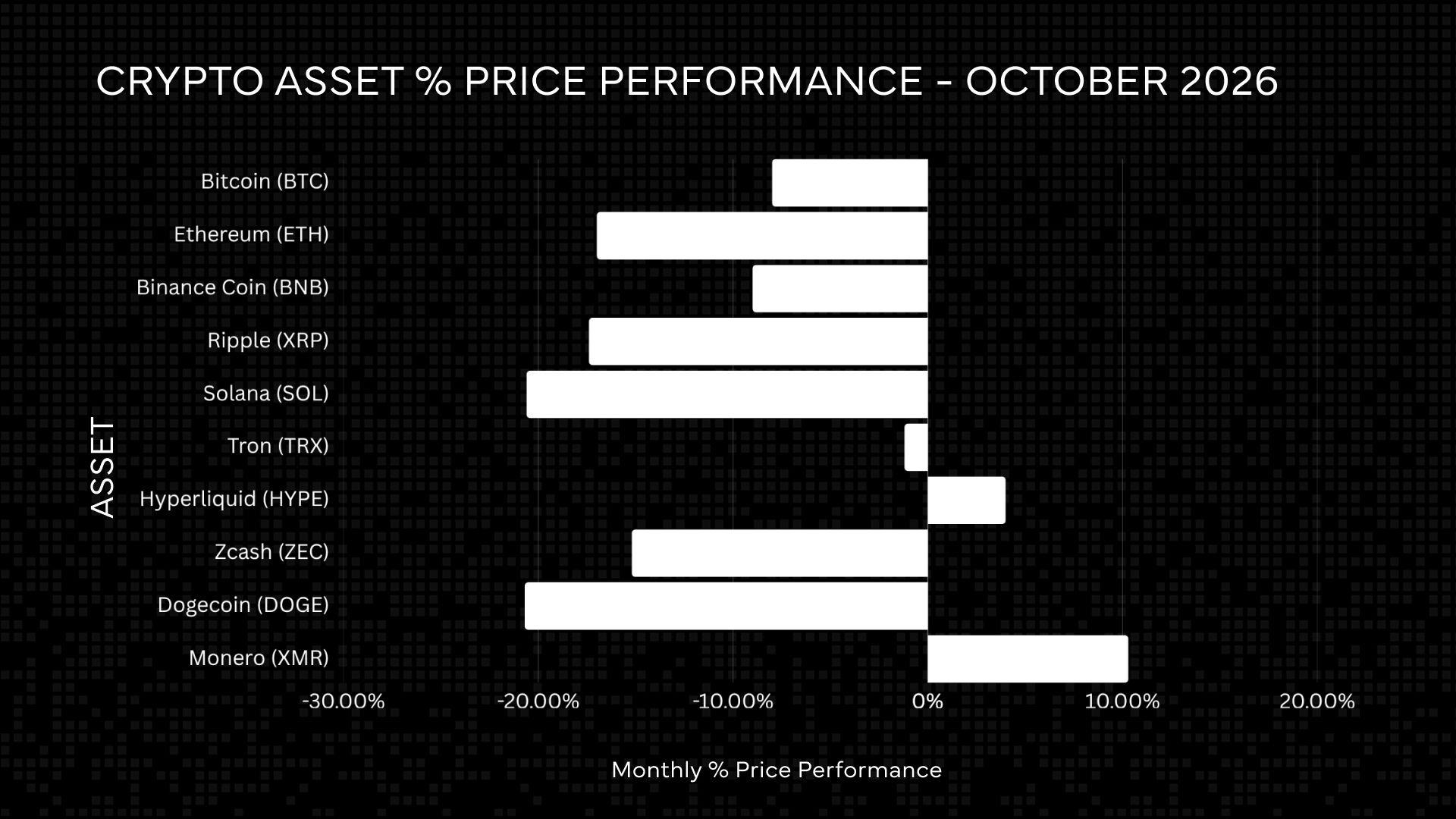
Bitcoin (BTC) opened the month around $84,100 and rallied up to $87,200 on October 2, before correcting down to around $77,400* to close out the month.
The crypto market selloff was broad. Solana (SOL) and Dogecoin (DOGE) each fell around 20%, while Ether (ETH) and XRP dropped 17.0% and 17.4%, respectively. Zcash (ZEC), September’s top performer, gave back 15.2%.
Monero (XMR) was the strongest performer, gaining 10.3%. On October 5, the US Financial Crimes Enforcement Network (FinCEN) withdrew its 2023 proposal to designate international crypto mixing as a primary money laundering concern, citing a possible “chilling effect on legitimate activity.” Market commentators linked the decision to easing fears of further exchange delistings for privacy coins, and XMR moved above $600 by October 19, although the direct impact is difficult to isolate.
Hyperliquid (HYPE) gained 4.0%, helped by news late in the month. On October 29, Intercontinental Exchange (ICE), the parent company of the New York Stock Exchange, announced a partnership with TradeXYZ to bring Hyperliquid-based perpetual futures to the US under a regulated framework, alongside a strategic investment in TradeXYZ. The plan remains subject to regulatory approval. HYPE rose 15% on the day, to around $91.
October brought Switzerland’s first spot Bitcoin ETF for retail investors, while full-quarter data confirmed Bitcoin’s strongest third quarter since 2017.
On October 20, the Swiss Financial Market Supervisory Authority (FINMA) approved the first exchange-traded fund open to Swiss retail investors that invests directly in Bitcoin. FINMA didn’t name the fund, but BIT Asset Management AG, the Swiss asset management subsidiary of digital asset platform BIT, confirmed that the approval covers its Bitcoin Fund ETF (ticker: BBIT). The issuer expects trading on the SIX Swiss Exchange to begin in November, and the fund is approved for public offering in Switzerland only.
To approve it, FINMA had to grant an exemption from the diversification requirements that normally apply to Swiss investment funds. The regulator based the exemption on Bitcoin’s comparatively long trading history and high trading volume relative to other cryptoassets. It also attached conditions, which included that supervised institutions must mitigate custody and operational risks in line with guidance FINMA published on January 12, 2026.
FINMA was explicit that approval doesn’t change the asset’s risk profile. It described Bitcoin as highly volatile, even when held through an approved fund, and warned that investors could lose a substantial part of their capital.
FINMA has permitted funds investing in baskets of cryptoassets since 2021, but this is the first time it has approved a fund that invests in Bitcoin alone and is open to the public. The regulator noted that other fund providers have already filed applications for Bitcoin ETFs. BIT has not yet disclosed the fund’s management fee or the name of its custodian.
Bitcoin finished its third quarter, which ended on September 30, up around 42%, according to CoinGlass data. That made Q3 2026 its strongest quarter since Q4 2024 and its best third quarter since 2017, when Bitcoin rose roughly 80% over the same three months. It also ended a run of three consecutive losing quarters dating back to Q4 2025.
The quarter opened with Bitcoin near $59,250 after a 20% decline in June and closed around $84,000. August did most of the work as Bitcoin rose more than 24% that month after the US Treasury expanded its liquidity-support buybacks at the long end of the curve, triggering a wave of short liquidations. July and September added roughly 5% and 7.4%, respectively.
US spot Bitcoin ETFs followed the same path. According to SoSoValue data, the funds recorded net inflows of $172 million in July, $3.52 billion in August and $2.65 billion in September, for approximately $6.34 billion across the quarter. That made Q3 their strongest quarter of 2026 and reversed roughly $5 billion in net outflows recorded in Q2.
*Closing price data is from October 30th, 2026, 4:15 pm GMT.
**ETF figures are based on aggregate US spot Bitcoin ETF flow data from Farside Investors available through October 28, 2026.