
Bitcoin
Bitcoin CPI
Venture Portfolio
Funds
Market Insights
Indicators






About
Contact

July 17, 2024



Following the introduction of the Ordinals protocol, Bitcoin token standards have rapidly developed, enabling the creation and management of Bitcoin-native assets like BRC-20 tokens and Runes.
This guide discusses the proposed BRC-555 token standard and its potential impact on the Bitcoin ecosystem.
BRC-555 is a new token standard for programmable Ordinals. Its modular structure allows users to modify individual Ordinal inscriptions or entire Ordinal collections.
This enhanced functionality is useful for creating, managing, and transferring Bitcoin Ordinals and establishes new use cases on the Bitcoin network.
Bitcoin Ordinals are inscribed with immutable data, making it nearly impossible to alter or update the original Ordinal inscriptions, thus limiting their functionality and use cases.
The BRC-555 token standard relies on a comprehensive infrastructure of parent-child relationships to modify individual Ordinal inscriptions, facilitating cost-effective updates.
In other words, by changing a few lines in your code you can simultaneously update all Ordinal inscriptions in your collection. The cost savings per update are applied to modified inscriptions, while payments are curtailed to sections that remain unaltered.
The BRC-555 standard offers a batch minting function that lowers the cost of inscribing for uniform Ordinal collections. This also reduces minting costs for Bitcoin Ordinals being issued in scale.
Through the parent-child model, users can delegate temporary control of their collection to developers while retaining ownership rights in a cold storage or multi-sig wallet.
Let’s discuss the pros and cons of this new proposed Bitcoin token standard.
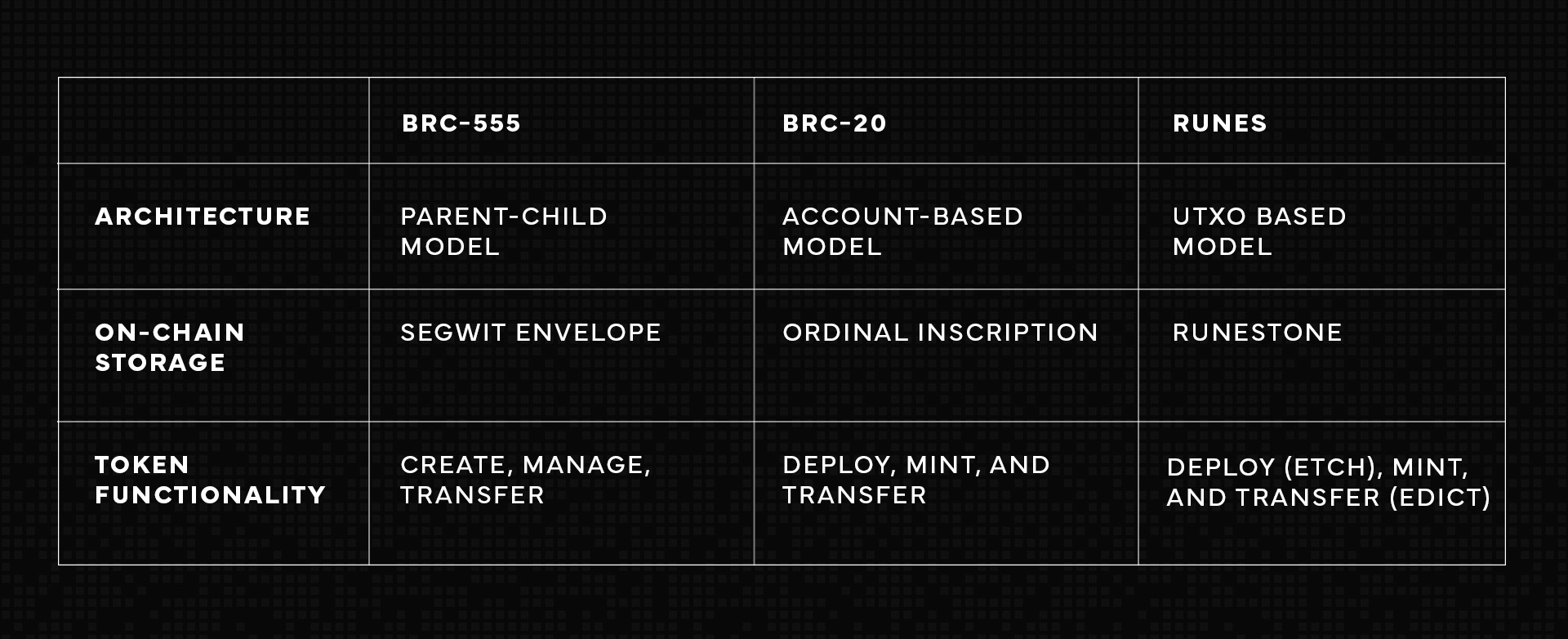
BRC-555 uses a parent-child model to make changes to Ordinal collections. Comparatively, BRC-20 uses an account-based model that stores tokens within specific Bitcoin addresses, whereas Runes deploys a UTXO-based model where tokens exist as satoshis with specific data inscriptions.
BRC-555 makes updates to Ordinal inscriptions in the Segwit envelopes of UTXOs. The BRC-20 protocol utilizes Ordinal inscriptions for data storage. On the other hand, the Runes protocol uses a new format in OP_RETURN for messages referred to as Runestones.
The BRC-555 standard supports advanced deployment, minting, and transfer of Ordinals. The BRC-20 protocol functions include deploying, minting, and transfer of Bitcoin fungible tokens. Runes protocol etches (deploys), mints, and edicts (transfers) runestones.
The BRC-555 protocol enables programmable Ordinal inscriptions and paves the way for dynamic products on Bitcoin. This will unlock new use cases for Bitcoin token standards and drive innovation in the Bitcoin ecosystem.
For example, BRC-555 supports features like staking, vesting, and governance mechanisms while improving scalability. Moreover, it could simplify creating and managing unique digital assets on Bitcoin, such as digital collectibles and in-game assets, which can be updated over time.
It will be exciting to see how the introduction of BRC-555 will impact the Bitcoin ecosystem once the token standard goes live.


