
Bitcoin
Bitcoin CPI
Venture Portfolio
Funds
Market Insights
Indicators






About
Contact

July 24, 2023


Since the Taproot upgrade went live in November 2021, developers have been experimenting with the Bitcoin blockchain creating new innovations like Ordinals, BRC-20, and now ORC-20.
Read on to learn about ORC-20 tokens, how they work, and how they differ from BRC-20 tokens.
ORC-20 is an open token standard that seeks to improve some of the features of the BRC-20 token standard. Just like BRC-20, ORC-20 is an experimental token standard that enables the issuance of assets on the Bitcoin blockchain. The OrcDAO created it at the end of April 2023.
ORC-20 maintains backward compatibility with BRC-20 while enhancing its security, scalability, and adaptability. Moreover, ORC-20 expands the scope of BRC-20 by supporting more data formats and eradicating the probability of double-spending.
BRC-20 is a token standard introduced in March 2023, enabling anyone to mint fungible tokens on the Bitcoin blockchain by employing Ordinal Theory.
Ordinal Theory entails allocating ordinal numbers to specific sats (the smallest bitcoin units) in the order in which they are mined, allowing individuals to identify, track, inscribe, and transfer them. BRC-20 tokens are generated using Ordinal inscriptions.
Although BRC-20 tokens have gained much popularity, mainly driven by investor speculation, they’re inefficient. Here are some of the limitations BRC-20 tokens face:
ORC-20 solves these issues in the following ways:
The ORC-20 token standard works in the same way as the BRC-20 token standard. However, instead of three functionalities (deploy, mint, and transfer), ORC-20 has four: deploy, mint, send, and cancel.
Let’s look at how these four functions work.
The deployment stage involves setting the parameters of your ORC-20 token. These parameters include the token’s ticker, supply, and token limit per mint. In BRC-20, the parameter options you can use would pretty much end here.
With ORC-20, however, you can set additional parameters, such as the number of decimals a token can be divided into and the inscription number. You can also create token tickers of any length and upgrade the maximum token supply later. ORC-20 data isn’t case-sensitive, giving you more flexibility.
You must use a platform like Unisat, which supports ordinal inscriptions, or a Taproot-enabled Bitcoin wallet to store these parameters within an individual sat in the JSON data format. ORC-20 supports JSON by default, but other formats are available.
Let’s assume you want to deploy a token named GENY on inscription number 27,000 with 18 decimal places. You’ve decided that your token’s maximum supply will be one million, and the limit will be 10,000 tokens per mint.
The data could look something like this:
“p”: “orc-20”,
“tick”: “GENY”,
“id”: “27000”,
“op”: “deploy”,
“max”: “1000000”,
“lim”: “10000”,
“dec”: “18”
Besides creating a new ORC-20 token from scratch, you can wrap an existing BRC-20 into an ORC-20 format. Migrating a BRC-20 token to the ORC-20 token standard is irreversible.
Minting entails generating the actual ORC-20 tokens. You’ll need to specify the number of tokens you want to mint (the maximum limit per token mint is 10,000 in ORC-20) and the inscription ID you entered in the deploy phase.
Sending or transferring tokens in the ORC-20 token standard uses the UTXO model. So, if you have 2000 GENY tokens and want to send 1000 of them to someone, you’ll have to send the remaining 1,000 tokens to yourself.
In ORC-20, a ‘send’ event is a partial transaction that can be tracked using a nonce. In Bitcoin, a nonce is a random number that miners use to iterate the output of their hash calculations.
The ORC-20 token standard allows you to cancel a partial transaction until the last step, where you send yourself the balance. To cancel a token transfer, you must specify the nonce.
According to Coinranking, there are 20+ ORC-20 tokens as of this writing. Orc, Ordinals, and Orcd as the top three ORC-20 tokens by market cap.
Here are a few details about these tokens:
Orc was the first ORC-20 token deployed on April 30, 2023. It has a supply of 21 million tokens that are currently 100% minted. According to Ordspace, Orc’s price at the time of writing was $0.36 and its market cap was $7,585,956.
The current number of people holding Orc is 641, while the number of transactions is 29,538.
Ordinals is an ORC-20 token deployed on May 3, 2023. All 21 million Ordinals tokens have been minted based on GeniiData. As of this writing, Ordinals’ price is $0.06 and its market capitalization is 1,264,326.
The number of Ordinals transactions recorded is 30,813. The token has 830 holders.
Orcd was deployed on May 12, 2023. It has a supply of 21 million tokens, which have all been minted. Interestingly, Orcd is trading at the same price as Ordinals as of this writing. The two tokens also have the same market cap.
Orcd has 791 holders and recorded 27,387 transactions.
ORC-20 tokens are still very new, meaning market activity is taking place over the counter (OTC), and is probably difficult to track. Nonetheless, Dune Analytics indicates that the total number of ORC-20 transactions is 358,465 as of June 23, 2023. Moreover, it states that the total fees paid on ORC-20 transactions are 23.31 BTC.
ORC-20 tokens are based on an experimental design that could gain traction or fade away depending on how the crypto community responds.
The ORC-20 token standard may also inspire better standards for token issuance on Bitcoin and provide future evidence on whether token issuance is a good application for the blockchain.
The OrcDAO created the ORC20 protocol at the end of April 2023 to enhance some of the features of the BRC-20 token standard. However, the ORC-20 token standard still poses the same financial risks as BRC-20 because it is experimental. Investors should, therefore, keep this in mind before purchasing ORC-20 tokens.
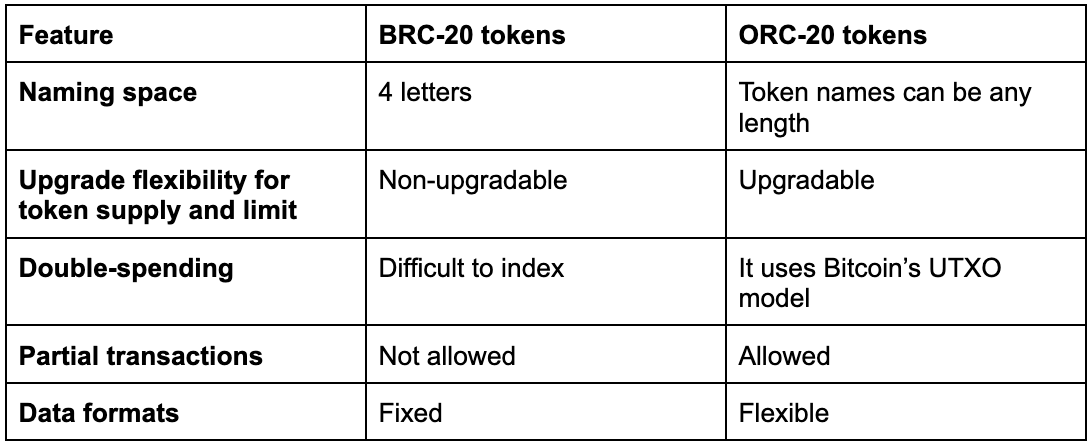
The BRC-20 token standard limits token ticker names to four letters, while the ORC-20 token standard has no size constraints. Secondly, ORC-20 permits token issuers to upgrade the supply and token limit of their tokens, while BRC-20 doesn’t.
BRC-20 only allows the JSON data format, while ORC-20 supports a wide range of data formats. Moreover, send transactions in ORC-20 are partial, meaning they can be canceled, while BRC-20 transactions are immutable, which means they cannot be reversed.


